


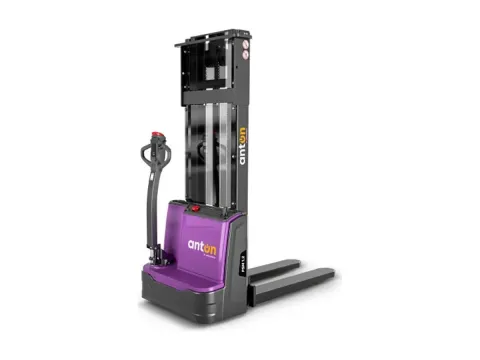
PSM 1.2 t Electric Stacker
- AntOn by Jungheinrich
- 2,430 mm lift
- Li-ion, built-in charger
170,705 UAH
Get a quote

 Request a call
 Warehouse RackingPallet, shelving, cantilever and drive-in racking, plus mezzanines
 Material Handling EquipmentForklifts, stackers, reach trucks and electric pallet trucks
 Warehouse AutomationConveyors, roller conveyors, sorters and warehouse lifts
 Plastic ContainersPlastic boxes and containers for storage and order picking
 Powered Roller Conveyors
 Gravity Roller Conveyors
 Belt Conveyors
 Warehouse Sorters
 Warehouse Lifts
 Conveyor Transfers
 Coming soonThis section will open shortlyRequest a call
Warehouse RackingPallet, shelving, cantilever and drive-in racking, plus mezzanines
Material Handling EquipmentForklifts, stackers, reach trucks and electric pallet trucks
Warehouse AutomationConveyors, roller conveyors, sorters and warehouse lifts
Plastic ContainersPlastic boxes and containers for storage and order picking
Powered Roller Conveyors
Gravity Roller Conveyors
Belt Conveyors
Warehouse Sorters
Warehouse Lifts
Conveyor Transfers
Coming soonThis section will open shortlyRequest a call
Pedestrian, self-propelled and platform electric stackers: lift heights up to 6000 mm in narrow aisles – new Li-ion models and used equipment from Europe.
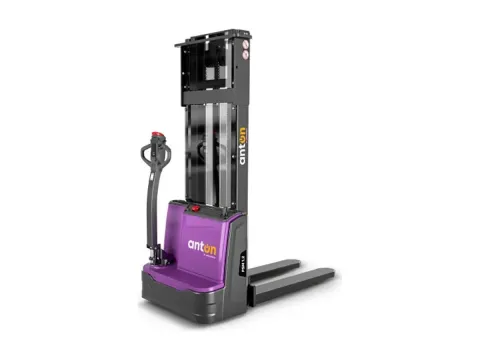
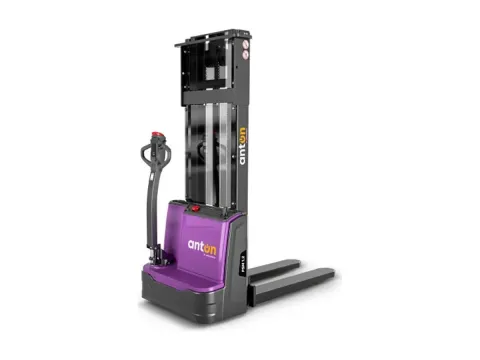
An electric stacker (powered pallet stacker) works inside warehouses and retail premises with dense racking and narrow aisles. It is productive, manoeuvrable and easy to operate: it moves loads of 1,000–1,500 kg, and some models up to 2,500 kg, over relatively short distances and lifts them to heights of up to 6,000 mm.
Lower and middle levels of pallet racking.
A compact body where a forklift would struggle for space.
Fast supply of pallets from reserve storage to picking.
Precise lifting without long breaks.
For racking work, check not only the rated load capacity but also the residual load capacity at the required height: a pallet on the fourth level puts a different load on the mast.
| Type | Typical tasks | What to check |
|---|---|---|
| Pedestrian (walk-behind) | Short routes, work at the racking | Lift height, battery, aisle |
| Self-propelled | Regular pallet movement between zones | Load capacity, speed, battery life |
| With platform | Longer routes during the shift | Operator comfort, brakes, dimensions |
| With cab | Intensive work over large areas | Visibility, protection, shift pattern |
| With initial lift | Ramps, thresholds, uneven areas | Ground clearance, stability, type of load |
A good fit when
Another solution is better when
 Racking
Pallet Racking
Medium-height racking
 Equipment
Electric Pallet Trucks
Moving pallets without lifting
 Equipment
Reach Trucks
When you need a greater lift height
A transparent process, with no juggling between separate suppliers and installers. You know what is happening at every step.
Start with a consultationWe clarify your needs, advise and make a preliminary equipment selection.
We measure and fully assess the warehouse: geometry, floor, aisles, work zones.
We produce drawings, a layout plan and a specification.
We select handling equipment and other equipment to suit the racking system.
We agree delivery and payment terms and sign the contract.
We manufacture racking systems and automation equipment.
We deliver structures and equipment to your site anywhere in Ukraine.
We install the racking, set up and commission automation, and hand over a ready-to-run warehouse.
A few short questions – an engineer will prepare a preliminary solution and an indicative cost for your warehouse.


For short routes and work at the racking, a pedestrian stacker is enough. If the operator covers longer distances during the shift, choose a model with a platform; for intensive work over large areas, choose one with a cab.
It is the permissible pallet weight at a specific lift height. It is lower than the rated capacity because a pallet on the top level puts a different load on the mast – so this is the figure you need to check.
Pedestrian, self-propelled, with a platform, with a cab and with initial lift – for ramps, thresholds and uneven areas. Find out more in the article “Electric stackers for warehouses: types, specifications and how to choose”.
Leave your details – an engineer will call you back and work out the cost.
Request received. Our specialist will contact you shortly.