


How Many Units of Handling Equipment Warehouses and Logistics Centres Need
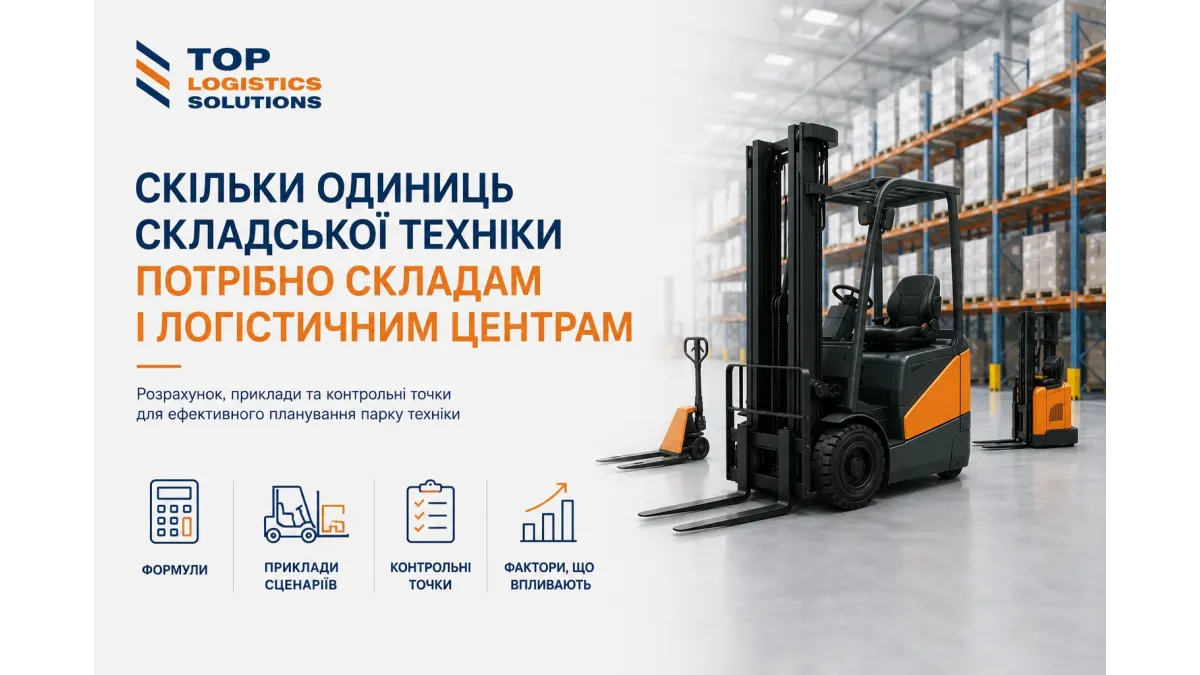
The number of handling equipment units is calculated from the volume of operations, the average time of one cycle and the real productive time of a machine. Warehouse floor area on its own does not determine the fleet you need: two facilities of the same size can have very different product flows. Peak load should be checked separately, because a calculation based on the average shift may not cover a two-hour peak in receiving or dispatch. Below we look at the formulas, typical scenarios and calculation checkpoints.
The basic calculation formula
Determine the required number of machine hours. Divide it by the productive time of one machine:
Machine hours = number of operations × average cycle time, min / 60
Then calculate the fleet:
Number of machines = machine hours / productive hours of one machine per shift
Round the result up. Productive hours are the time during which the machine actually performs operations. If an eight-hour shift gives 6 hours of actual work, use 6 in the formula.
For the peak period, run a separate check:
Machines at peak = operations in the peak period × cycle time / productive minutes of one machine in that period
Choose the final fleet size based on the larger of the two results.
These formulas are used to calculate the core warehouse equipment. Groups for horizontal transport, racking work and loading areas are calculated separately.
 Equipment from this articleMaterial Handling EquipmentView category
Examples: common warehouse and logistics complex scenarios
- Horizontal pallet transport. 300 movements have to be completed per shift. The average cycle takes 3 minutes, and the productive time of one machine is 6 hours. This gives 300 × 3 / 60 = 15 machine hours. 15 / 6 = 2.5, so 3 machines are needed.
- Putting pallets into and retrieving them from racking. The plan is 240 cycles per shift, the average cycle lasts 5 minutes, and productive time is 6.5 hours. The requirement is 240 × 5 / 60 = 20 machine hours. 20 / 6.5 = 3.08, so the working fleet is 4 machines.
- Peak dispatch. 180 pallets have to be moved in two hours, and one cycle takes 2.5 minutes. The total workload is 450 minutes. If each machine is actually available for operations for 100 minutes of those two hours, 450 / 100 = 4.5. The peak requires 5 machines, even if the average-shift calculation shows fewer.
Checkpoints before approving the fleet
Based on the actual cycle at your specific warehouse:
- measure the cycle from receiving a task to being ready to carry out the next one;
- count receiving, dispatch, replenishment and internal movements separately;
- check the busiest 1–2 hours of the shift;
- record downtime for charging, operator changeovers and waiting for loads;
- determine the number of machines needed to maintain the planned product flow during servicing.
The last indicator defines the reserve. If at least four machines are required and the warehouse has to maintain planned productivity while one machine is out for servicing, the fleet consists of four working units and one reserve unit.
What can change the result
The actual cycle time has the greatest effect on the number of machines. It is affected by route length, lift height, aisle width and traffic intersections. An increase in the average cycle from 4 to 5 minutes means 25% more machine hours for the same volume of operations.
Also take into account batteries and charging, the shift pattern, peaks at the docks and uneven product flow during the day. After start-up, compare the actual cycle time with the calculated one. A systematic deviation is an important signal for management that the fleet needs to be recalculated using real data.
CategoryMaterial Handling EquipmentForklifts, reach trucks, stackers and electric pallet trucks: sales and service.View category
 CategoryElectric ForkliftsSelection of forklifts, forks and attachments for your loads.View category
 CategoryReach TrucksEquipment for high pallet racking and narrow aisles.View category
 CategoryElectric StackersCompact equipment for stacking pallets in small warehouses.View category
 CategoryElectric Pallet TrucksElectric pallet trucks for moving pallets around the warehouse.View category
Show us your warehouse.
We’ll take a look, then show you how to improve it
Leave your contact details and briefly describe the task. A TOP Logistics Solutions specialist will contact you, clarify the details and propose the next step.