


Pallet Type and Racking Dimensions: EUR, FIN or US Pallet
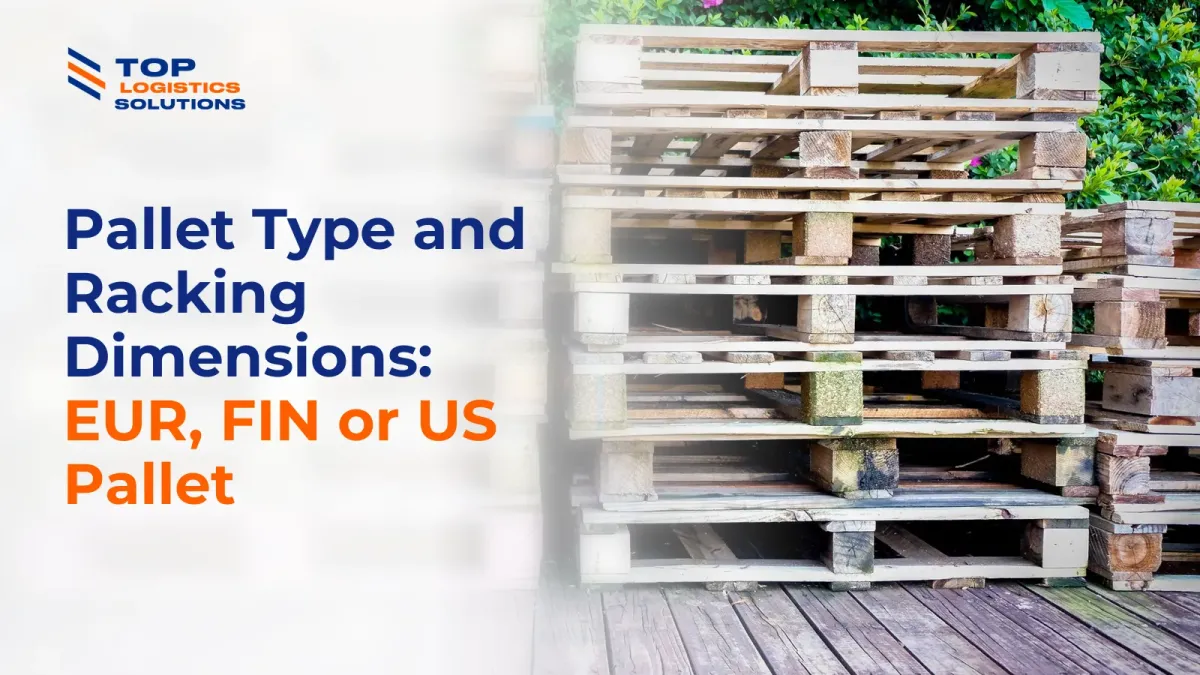
Pallet racking dimensions follow from the pallet: its front width sets the beam length, its depth sets the frame depth and the load height sets the level pitch. So first decide which pallets will be stored and in which orientation, and only then choose the bays. For a EUR pallet of 1200×800 mm the classic solution is three pallets on a 2,700 mm beam.
Pallet standards: sizes and loads
| Type | Size, mm | Where common | Typical load |
|---|---|---|---|
| EUR (EPAL) | 1200×800 | Europe, retail, FMCG | up to 1,000–1,500 kg |
| FIN | 1200×1000 | Northern Europe, industrial goods | up to 1,000–1,500 kg |
| UK / industrial | 1200×1000 | United Kingdom, chemicals, building materials | 1,000–2,000 kg depending on design |
| US (48×40 in) | 1219×1016 | North America, imported goods | depending on design |
The figures are indicative: the data sheet of the actual pallet and the way it is supported in the racking take priority.
 Equipment from this articlePallet RackingView category
How to orient the pallet on the beams
The standard layout places the pallet with its long side into the depth of the racking, resting at its edges on the front and rear beams. A EUR pallet then takes 800 mm of the front, a FIN or industrial pallet 1,000 mm and a US pallet 1,016 mm.
Turning the pallet with its long side along the beam gives fewer pallets per level and needs pallet support bars or decking. A EUR pallet 800 mm deep on a 1,100 mm frame does not reach both beams.
How the pallet sets the beam length
Beam length is calculated with the formula:
L = n × B + (n + 1) × a,
where n is the number of pallets per level, B is the pallet front width and a is the clearance between pallets and between a pallet and the upright. Minimum clearances are set by DSTU EN 15620 (EN 15620) and grow with level height: 75 mm is usual at lower levels, 100 mm or more at high levels.
- 2 EUR pallets: 1,600 + 3 × 75 = 1,825 mm;
- 3 EUR pallets: 2,400 + 4 × 75 = 2,700 mm;
- 2 pallets of 1200×1000: 2,000 + 3 × 75 = 2,225 mm, in practice a 2,300 mm beam is used;
- 3 pallets of 1200×1000: 3,000 + 4 × 75 = 3,300 mm.
All of these options fall within the TOP LS beam range of 1,825 to 3,600 mm, and a beam pair carries up to 6,000 kg.
Frame depth and pallet overhang
For a pallet 1,200 mm deep, a 1,100 mm frame is usually chosen. The pallet overhangs by about 50 mm at the front and rear: it sits securely on both beams. A US pallet 1,219 mm deep overhangs slightly more – check this against the manufacturer's layout.
Level height: clearance above the load
The level pitch is calculated as follows:
pitch = load height including pallet + vertical clearance + beam profile height
Vertical clearance for lifting the pallet above the beam also grows with height: about 75–100 mm at lower levels and more at upper levels. A EUR pallet itself is 144 mm high and is included in the load height.
Drive-in lane and pallet type
In drive-in racking the pallet stands not on beams but on two rails running along the lane. TOP LS lane width is 1,350–1,450 mm, so the pallet sits with its 1,200 mm side across the lane, resting at its edges on both rails. One pallet position carries up to 2,000 kg.
In a lane, a single pallet type and good pallet condition are critical: a pallet of a different width or with a damaged bottom board can sag between the rails. A US pallet is 1,219 mm wide, 19 mm wider than a European one, so lanes for a mixed pallet fleet are checked separately. More detail is in our article on drive-in racking.
Aisle width and trucks
The working aisle Ast in a truck data sheet is given for a pallet of a specific size and orientation. Pallets of 1200×800 and 1200×1000 give different Ast values, and the difference multiplies with the number of aisles. More detail is in our article on aisle width and turning radius.
What to do with a mixed pallet fleet
- size beams for the widest pallet that will actually go on the level, or allocate separate runs to each type;
- do not put 1,000 mm pallets on a level designed for three EUR pallets – with clearances they will not fit;
- for pallets turned sideways and non-standard containers, provide pallet support bars or decking;
Hypothetical example: one bay for EUR pallets
Hypothetical input data: EUR pallets of 1200×800 mm, weight up to 1,000 kg, load height including pallet 1,500 mm, three pallets per level.
- beam: 3 × 800 + 4 × 75 = 2,700 mm;
- load per beam pair: 3 × 1,000 = 3,000 kg – within 6,000 kg;
- level pitch: 1,500 + 100 + 120 (assumed profile height) = 1,720 mm;
- three beam levels plus the floor level: 4 × 3 = 12 pallet positions per bay;
- bay load from three levels: 9,000 kg, checked against the permitted value for the frame.
If the warehouse uses 1200×1000 pallets instead of EUR, the same 2,700 mm beam takes only two – 8 pallet positions instead of 12. That is why the pallet type is fixed in the technical brief before pallet racking is calculated. The calculation for the whole warehouse is covered in our article on calculating and laying out racking.
Frequently asked questions
What are the dimensions of a EUR pallet?
1200×800 mm, 144 mm high. In racking it is usually placed with its long side into the depth, so it takes 800 mm of the front.
How many EUR pallets fit on a 2,700 mm beam?
Three, with 75 mm clearances between the pallets and the uprights. For two EUR pallets a 1,825 mm beam is enough.
What frame depth does a 1,200 mm pallet need?
Usually 1,100 mm, with an overhang of about 50 mm at the front and rear.
Can EUR and FIN pallets be stored in the same racking?
Yes, if the beams are sized for the wider pallet or separate levels or runs are allocated to each type.
CategoryPallet RackingSelective pallet racking: design, manufacturing and installation for your loads and equipment.View category
 CategoryDrive-in RackingMore pallet positions in the same floor space for uniform goods.View category
 CategoryReach TrucksEquipment for high pallet racking and narrow aisles.View category
 CategoryElectric StackersCompact equipment for stacking pallets in small warehouses.View category
Show us your warehouse.
We’ll take a look, then show you how to improve it
Leave your contact details and briefly describe the task. A TOP Logistics Solutions specialist will contact you, clarify the details and propose the next step.