


Aisle Width and Turning Radius: How Equipment Dimensions Dictate Racking Layout
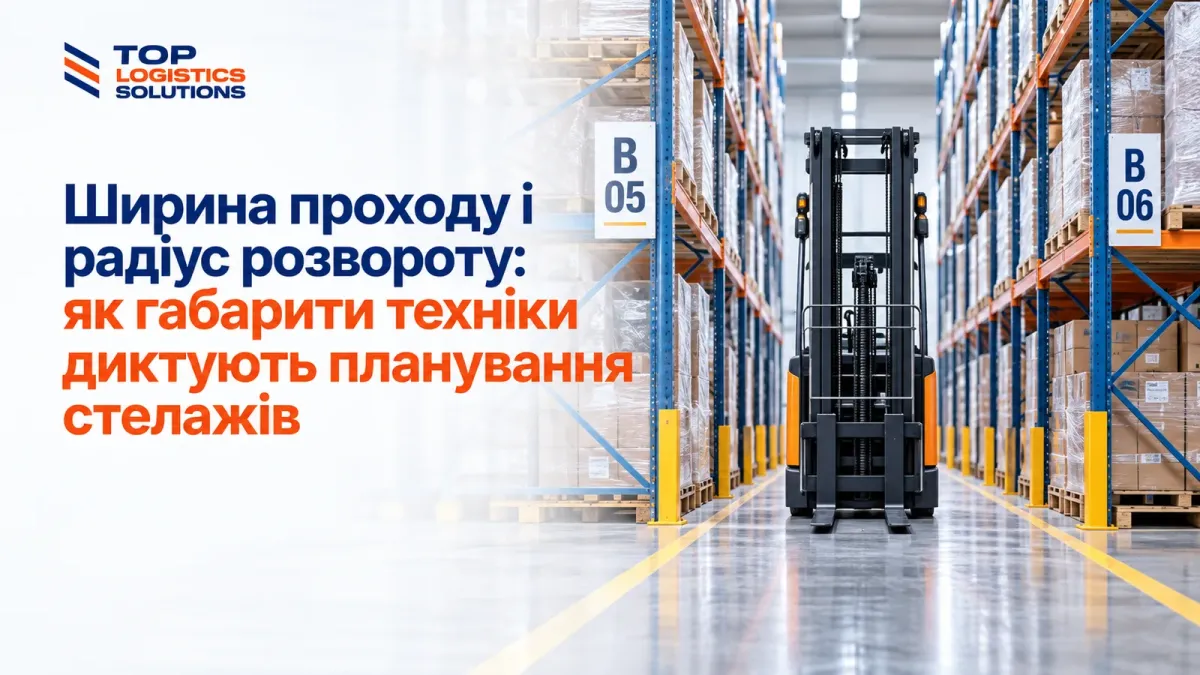
Aisle width is determined by the working aisle of a specific machine carrying a pallet of a fixed size. The turning radius describes the manoeuvrability of the machine itself, but does not take into account the full path of the load when it is placed at right angles to the racking. That is why equipment selection and row layout should always be done together. A difference of even 0.5 m across several aisles can change warehouse capacity by hundreds of pallet positions.
How the working aisle differs from the turning radius
For layout planning, use the manufacturer's working aisle width Ast for the required pallet size and orientation. This parameter already accounts for the geometry of the machine with its load during stacking. Use the turning radius in addition for intersections, row ends and manoeuvring areas.
Enter the pallet dimensions, maximum weight, Ast, lift height and residual load capacity at the top level in the specification. This way, warehouse equipment is matched to the real geometry of the building.
Also check the width of the cross aisle at the row ends. The machine has to leave the aisle, turn and enter the next row with a working pallet. For this, use the manufacturer's dimensions of the machine with its load and the actual geometry of columns, doors and barriers.
 Equipment from this articleReach TrucksView category
How the type of machine changes the layout
More compact equipment makes it possible to reduce aisle widths, but each class solves different operational tasks.
- a standard counterbalance forklift is convenient for general-purpose routes and work at the docks;
- warehouse stackers suit shorter internal routes and moderate heights;
- a reach truck is designed for high-bay pallet systems and a narrower working aisle.
Take the final figure from the data sheet of the specific model. Additional criteria for choosing compact machines are analysed in the guide to electric stackers. You can read more about working at height in the article on equipment for narrow aisles.
How 50 cm of aisle turns into pallet positions
The economics are calculated using the full module: depth of the racking row + aisle width.
Take an example warehouse with 30 m of usable width and back-to-back (double) racking rows 2.4 m deep.
With a 3.5 m aisle the module takes up 5.9 m; with a 3.0 m aisle, 5.4 m. Five modules in the first scenario need 29.5 m, and five in the second need 27 m. The 2.5 m freed up already makes it worth checking whether an additional row fits in the overall layout.
If the new row has 40 bays, 4 levels and 2 pallets per level, it adds 40 × 4 × 2 = 320 pallet positions. This is how the racking configuration is translated from centimetres into capacity.
When comparing two layouts, count the pallet positions across the entire usable area, including end aisles and manoeuvring areas. An additional row may require a different cross-aisle width or a change to the receiving area. That is why each scenario should be checked as a complete traffic plan: racking, aisles, intersections and turning points.
When a narrow-aisle warehouse pays off
A narrower aisle is justified if the value of the additional capacity exceeds the difference in the cost of the equipment and its operation. For the calculation, determine how many additional pallet positions the new layout provides, estimate their financial benefit and compare it with the additional costs of equipment, charging infrastructure and service.
Before approving the layout, check Ast with a working pallet, lift height, residual load capacity, peak product flow in the aisle and the number of pallet positions in each scenario. For a narrow-aisle warehouse, the optimum option is the one that delivers the required throughput at the maximum economically justified capacity.
CategoryReach TrucksEquipment for high pallet racking and narrow aisles.View category
 CategoryElectric StackersCompact equipment for stacking pallets in small warehouses.View category
 CategoryPallet RackingSelective pallet racking: design, manufacturing and installation for your loads and equipment.View category
 In stock
ProductToyota RRE-140-HToyota reach truck for narrow aisles and high racking.Learn more
Show us your warehouse.
We’ll take a look, then show you how to improve it
Leave your contact details and briefly describe the task. A TOP Logistics Solutions specialist will contact you, clarify the details and propose the next step.