


Reach Trucks for Narrow-Aisle Warehouses: How to Choose by Lift Height and Load, and Whether to Buy or Rent
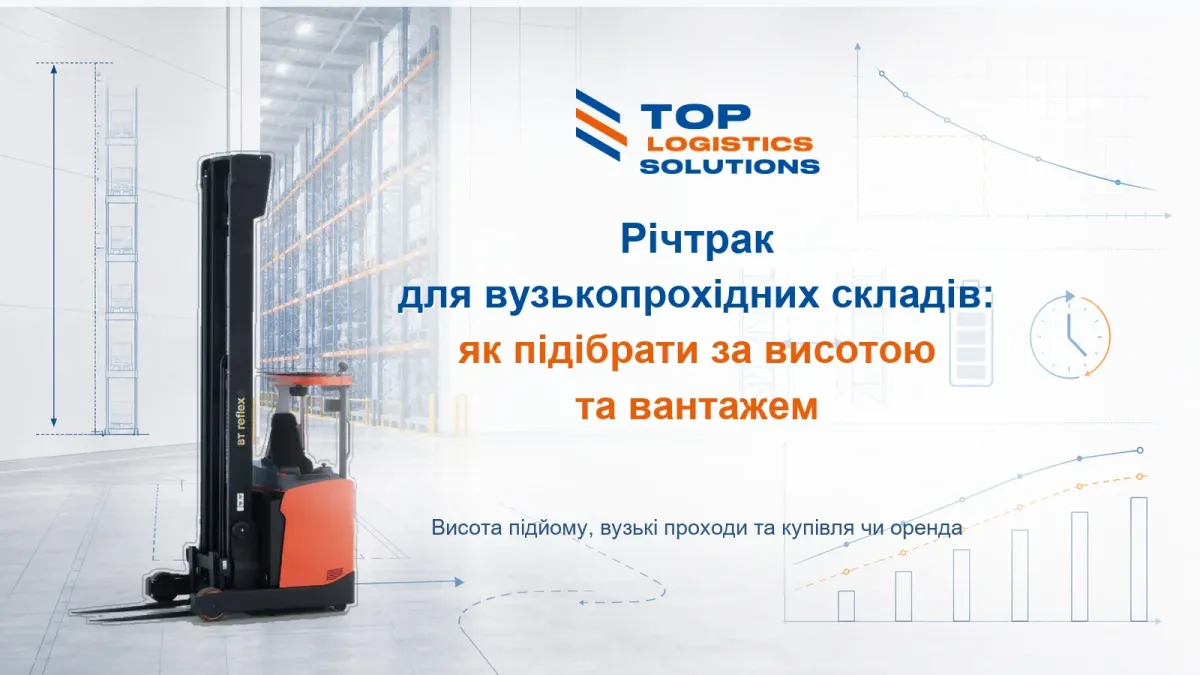
A reach truck is an electric warehouse machine for moving pallets and working with high racking in narrow aisles. Its extending mast or carriage brings the load close to the chassis, which reduces the space needed for turning. This type of equipment is selected by pallet weight at working height, aisle width and shift pattern.
What to check before choosing a reach truck
The working configuration is defined by the heaviest pallet that has to be placed at maximum height. The load capacity chart of a specific model shows the permitted weight, taking into account lift height, load centre and fitted attachments.
When selecting reach trucks for a warehouse, record five parameters:
- the maximum pallet weight including packaging;
- the height of the top beam and the working lift margin;
- the aisle width for right-angle stacking;
- the door height and the lowered mast height;
- shift length and the number of operations per hour.
For Double Deep racking, models with extended-reach forks are used to place or retrieve pallets from the second position in depth. This configuration has its own load capacity ratings, so the calculation is made for the actual reach and height.
The charging schedule should be matched to the battery type and operating mode. If the machine runs over several shifts, check whether opportunity charging or a battery swap is possible.
 Equipment from this articleReach TrucksView category
Buying or renting a reach truck: how to compare costs
Buying pays off when the machine works regularly over several years. Renting is a better fit for a short season, for testing a new warehouse format or for a temporary peak in throughput. The decision is made on the total cost over the same period.
Cost of ownership = equipment price + charging equipment + service + financing costs − residual value
Rental cost = monthly rate × number of months + delivery + charges for excess operating hours
Electricity is consumed in both scenarios, so it can be left out of the comparison. Service is counted only to the extent that the owner or the renter actually pays for it.
Example case: stable operation over three years
The indicative price of a reach truck with charging equipment is 1,150,000 UAH. Over three years the company will spend 270,000 UAH on scheduled maintenance and can then sell the machine for 450,000 UAH.
Total cost of ownership: 1,150,000 + 270,000 – 450,000 = 970,000 UAH.
Renting a comparable machine costs 55,000 UAH per month with scheduled servicing included. Delivery to the warehouse and return of the equipment add another 40,000 UAH.
Costs over 36 months: 55,000 × 36 + 40,000 = 2,020,000 UAH.
Under these conditions, buying saves 1,050,000 UAH. The approximate break-even point comes after 18 months of use. For continuous operation over two to three years, owning the machine gives better economics.
Example case: one four-month season
A new warehouse needs a reach truck for four months to handle seasonal stock. The rental rate is 55,000 UAH, and delivery both ways is 40,000 UAH.
Cost of the season: 55,000 × 4 + 40,000 = 260,000 UAH.
Buying requires 1,150,000 UAH up front and creates an asset the company will use in later periods. Renting limits costs to the current season and lets you test the machine's productivity, battery performance and compatibility with the racking. For a project with an uncertain continuation, this option saves 890,000 UAH of working capital at the launch stage.
Choose to buy if the equipment will work for most of the year, the warehouse layout is approved and the expected period of use exceeds the calculated break-even point. Renting suits seasonal loads, a trial launch, temporary replacement of a machine or a short increase in throughput. In both cases, check the load capacity, battery specification, operating-hours limit and service terms.
CategoryReach TrucksEquipment for high pallet racking and narrow aisles.View category
 In stock
ProductToyota RRE-140-HToyota reach truck for narrow aisles and high racking.Learn more
 CategoryPallet RackingSelective pallet racking: design, manufacturing and installation for your loads and equipment.View category
Show us your warehouse.
We’ll take a look, then show you how to improve it
Leave your contact details and briefly describe the task. A TOP Logistics Solutions specialist will contact you, clarify the details and propose the next step.