


Warehouse Equipment Maintenance: What Breaks Down and How to Plan Servicing
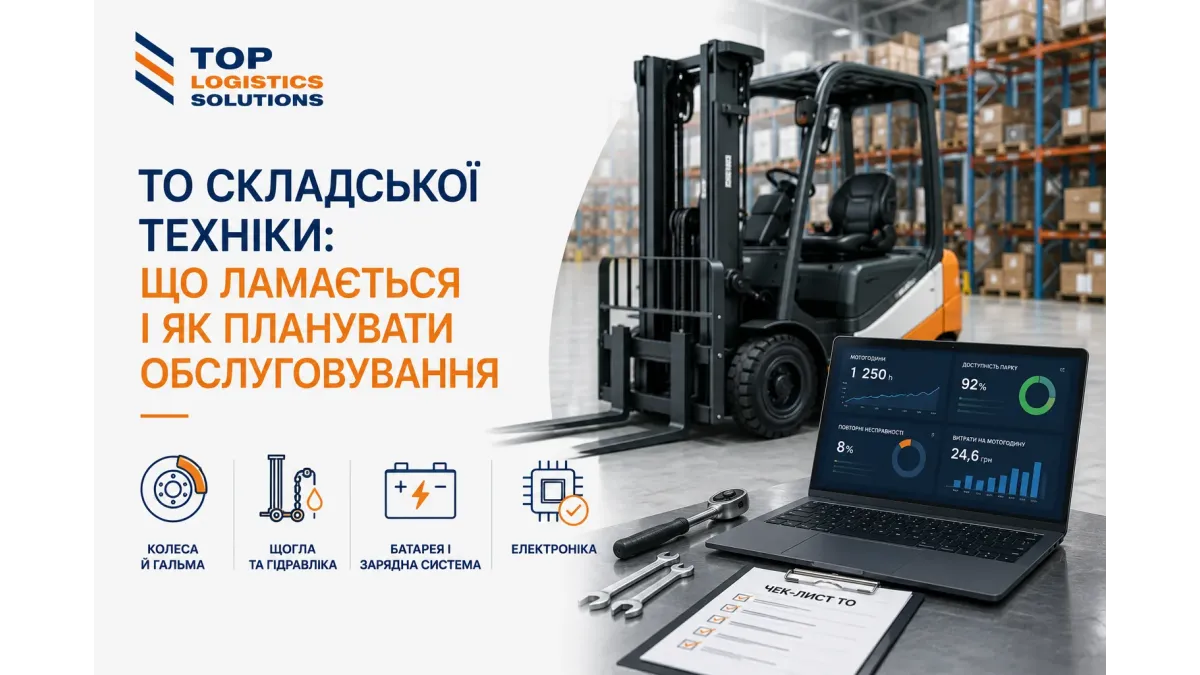
Maintenance of warehouse equipment is best planned around the operating hours of each machine, its fault history and the actual utilisation of the fleet. Spread scheduled work across service windows so that the required number of machines stays in operation at any one time. For modern forklifts and stackers, add telematics, remote diagnostics and failure prediction to the calendar. This approach lets you track two key indicators: fleet availability and maintenance cost per operating hour.
Which components need the most attention
Most of the routine work concerns the running gear, the lifting mechanism, the power system and the electronics. For management reporting, it is convenient to divide them into four groups:
- wheels and brakes: record wear, replacements and repeat repairs;
- mast and hydraulics: keep separate records for chains, rollers, hoses and leaks;
- battery and charging system: monitor cycles, temperature and charging history;
- electronics: store error codes together with the repairs carried out.
The most valuable information emerges over time. If the same component regularly causes downtime, compare its costs over several months with the price of replacing the component or the machine, so that you can make an informed decision between buying new equipment and a major overhaul.
 Equipment from this articleMaterial Handling EquipmentView category
How to build a maintenance schedule without a long drop in productivity
A rational schedule sends machines for servicing one after another rather than in large groups. First, divide the fleet by criticality and operating hours, then place the service windows in hours of lower product flow.
For example, with 20 machines, servicing two units at the same time leaves 90% of the fleet available, while five units leave only 75%. The rate at which operating hours build up also differs. A machine running 160 hours a month will reach the same service threshold twice as fast as a machine running 80 hours.
This way, warehouse equipment is serviced according to actual use. For each machine, it makes sense to record:
- hours of downtime;
- service costs per operating hour;
- repeat faults;
- actual use per shift.
How predictive maintenance, AI and smart diagnostics are changing modern servicing
Predictive maintenance moves some decisions from the calendar to the data from the machine itself. Telematics collects operating hours, error codes, impacts, battery temperature, charging cycles and other available parameters. The system sees changes in the readings before a fault turns into prolonged downtime. This makes it possible to plan repairs in advance without a significant drop in overall fleet productivity.
AI adds pattern analysis. The algorithm compares current telemetry with the history of a specific machine or fleet, finds unusual deviations and sets the priority of inspections. Smart diagnostics can send the central service team the error code, the time it occurred and related parameters before work starts.
As a result, some interventions can be moved into short service windows between load peaks. The technician then starts diagnostics with a specific component, without spending time searching for the cause from scratch.
What to monitor at fleet level
Four indicators are enough to manage maintenance:
- the share of available machines;
- hours of downtime;
- service costs per operating hour;
- the number of repeat faults.
Monitor them in groups by equipment type and by shift.
If part of the fleet consistently accumulates more downtime and repair costs under the same workload, this is already a basis for a decision on repair, redistribution of work or replacement of the machine. In this way, maintenance becomes a practical tool for the head of logistics to manage warehouse productivity.
CategoryMaterial Handling EquipmentForklifts, reach trucks, stackers and electric pallet trucks: sales and service.View category
 CategoryElectric ForkliftsSelection of forklifts, forks and attachments for your loads.View category
 CategoryDiesel & LPG ForkliftsDiesel and LPG forklifts for heavy loads and outdoor work.View category
 CategoryElectric StackersCompact equipment for stacking pallets in small warehouses.View category
Show us your warehouse.
We’ll take a look, then show you how to improve it
Leave your contact details and briefly describe the task. A TOP Logistics Solutions specialist will contact you, clarify the details and propose the next step.