


Lead-Acid or Lithium-Ion Batteries for Warehouse Equipment: Which to Choose
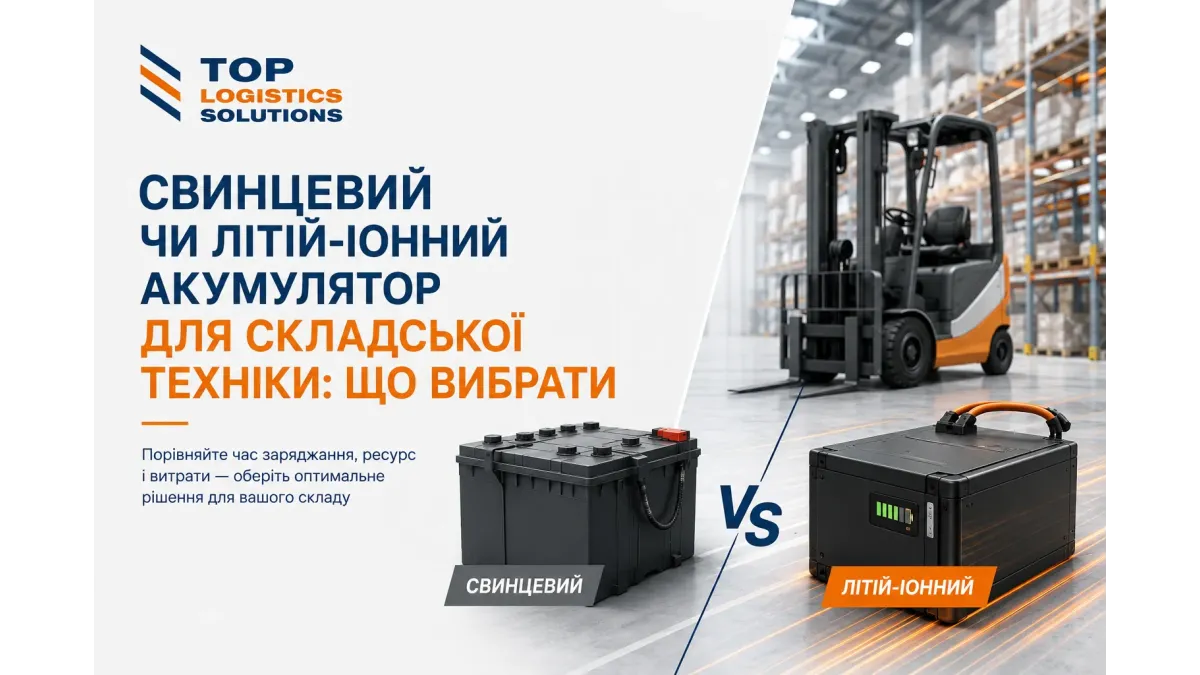
A lead-acid battery is the better option for a single-shift warehouse with a long overnight charging window, while lithium-ion suits two- and three-shift operation, where charging time and equipment availability are decisive. When choosing, compare the battery price, the number of operating hours, the charging infrastructure, maintenance and the need for spare batteries. The difference between the technologies is clearest when you compare hours of downtime and service life in thousands of cycles.
Charging time: the difference determines the number of shifts
The typical cycle for a conventional lead-acid battery is "8–8–8":
- 8 hours of operation;
- 8 hours of charging;
- 8 hours of cooling.
For a single shift this is a normal routine: after work ends, there are 16 hours until the next start.
A lithium-ion battery shortens the cycle. For example, in Jungheinrich equipment the batteries charge fully in 60 minutes and to 50% in about 20 minutes. The stated operating range is 8–16 hours. For a lead-acid battery, the same manufacturer quotes 360–720 minutes of charging and 6–12 hours of operation.
This is why, in three-shift operation, lithium supports opportunity charging, while lead-acid chemistry requires battery swaps.
 Equipment from this articleElectric ForkliftsView category
How costs change over the service life
A lead-acid battery has a lower initial price but needs regular topping up with water and cleaning. In multi-shift operation, spare batteries and space for charging them are added on top. Typical service life is 1000–1500 cycles. Lithium-ion batteries for Toyota forklifts withstand up to 9,000 charging cycles. They use 16% less energy when recharging.
As a result, lead-acid batteries are better suited to smaller operations, temporary projects and gradual development of a logistics system, while lithium batteries deliver savings in large warehouse complexes.
Which scenario is optimal for your warehouse
The choice depends on the actual daily workload of your warehouse equipment:
- 1 shift of 8 hours: a lead-acid battery, if a lower initial budget is the priority and overnight charging is available;
- 12–16 hours of operation: a lithium-ion battery with top-up charging during scheduled breaks;
- 3 shifts or 24/7: a lithium-ion system with charging points next to the areas where equipment regularly stands idle;
- a small fleet with a low workload: lead-acid technology leaves more budget for the fleet itself.
To give a sense of scale: under the conventional "8–8–8" cycle, one machine running round the clock uses three lead-acid batteries in rotation. For a fleet of 10 such machines, that is already 30 sets. With lithium-ion, the battery stays in the machine and is topped up during short pauses.
What constraints to build into the decision
For a lead-acid system the main constraint is time: 8–12 hours of charging plus about 8 hours of cooling after every 8 hours of use. Lithium, by contrast, shifts the costs to the start: the initial price is higher, and the charging points have to be placed where the equipment actually stands idle. Opportunity charging is possible even during breaks of 5–10 minutes.
Switching to lithium may also require different charging equipment and a redesign of the charging areas. That is why the final calculation should be built from five cost items: batteries, chargers, spare sets, maintenance and hours of downtime. Comparing this total over the same operating period shows which scenario is economically stronger.
When planning the purchase of equipment and batteries, also take into account plans to scale up the warehouse. If the volume of operations is expected to grow significantly or to rise periodically, plan at least a partial conversion of the machines to lithium batteries.
CategoryElectric ForkliftsSelection of forklifts, forks and attachments for your loads.View category
 In stock
ProductCBH Electric Forklift 2.0 / 2.5 / 3.0 tLi-ion 80 V, load capacity 2.0 / 2.5 / 3.0 t.Learn more
 In stock
ProductPSM Electric Stacker 1.2 tLi-ion, lift height 2430 / 2930 / 3530 mm.Learn more
 CategoryElectric StackersCompact equipment for stacking pallets in small warehouses.View category
 CategoryElectric Pallet TrucksElectric pallet trucks for moving pallets around the warehouse.View category
Show us your warehouse.
We’ll take a look, then show you how to improve it
Leave your contact details and briefly describe the task. A TOP Logistics Solutions specialist will contact you, clarify the details and propose the next step.