


Warehouse Automation Budget: What Makes Up the Price and How Long Payback Takes
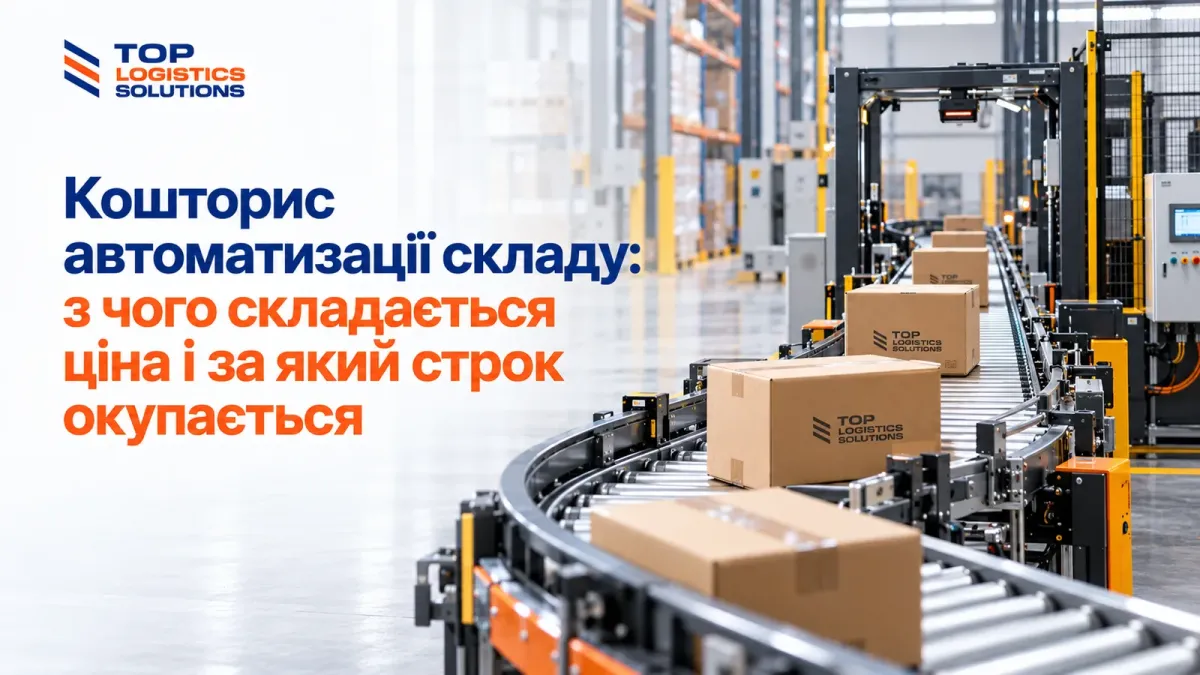
An automation budget is made up of equipment, design, installation, control systems, integration and commissioning. The payback period is determined by the net annual benefit: operating cost savings + productivity gain − new costs of operating the system.
That is why, to draw up an accurate budget, you need to record the current product flow, the peak load and the required productivity after start-up.
What an automation budget consists of
Basic CAPEX can be calculated with the formula: equipment + design + installation + controls and software + integration + commissioning.
Equipment includes conveyors, powered roller conveyors, accumulation sections, sensors and other mechanical components. Design covers line routing and the calculation of throughput and load transfer points. Electrical installation, automation, data exchange with the WMS or ERP and a test run are separate budget items.
Warehouse automation can cover a single operation or several linked zones. Splitting the budget by functional area lets you see the price of each stage and compare it with the expected benefit.
For each budget item, state the quantity, unit price, installation and related work. For example, an additional conveyor section may require sensors, cable routes, a control cabinet and software changes. This shows which component drives up the budget if the length or throughput of the line changes.
 Equipment from this articleWarehouse AutomationView category
How to choose the level of automation for your product flow
The solution is selected according to the number of load units per hour, route length and the number of distribution points.
For short movements of cartons between two zones, a gravity roller conveyor or a short powered section is used. A continuous flow between several zones already requires a belt conveyor or a branched conveyor line.
When goods have to be distributed in several directions, a warehouse sorter is added to the system. For warehouse conveyor systems, the main design parameter is the throughput of the entire line in units per hour.
Practical automation configurations are collected in our overview of solutions for 2026. Specific scenarios for an industry warehouse are covered in the article on solutions for the automotive sector.
How to calculate the annual economic benefit
Annual net benefit = labour savings + machine-hour savings + additional operational benefit − new OPEX.
An example: before start-up the process requires 40 person-hours a day, after start-up 24. The saving is 16 hours every day, or 4,000 hours over 250 working days. At a full cost of 180 UAH per working hour, this is 720,000 UAH a year. Electricity, service, spare parts and other new operating costs are deducted from this amount.
Take the baseline for comparison from the same period: several typical weeks, plus the peak load separately. The annual benefit will then be based on the actual volume of operations.
How to calculate payback
In a simple model, payback is calculated with the formula: CAPEX / annual net economic benefit.
For example, if the project costs 2.4 million UAH and the net benefit is 800 thousand UAH a year, the payback period is 3 years.
For a longer horizon, calculate the total cost of ownership: CAPEX + operating costs over the chosen period, for example five years. If the system makes it possible to handle a larger product flow with the same staff and in the same floor area, include the financial result from the additional volume in the model as well. Before approving the project, record the current and peak product flows, the required throughput, CAPEX, annual OPEX and the net annual benefit.
CategoryWarehouse AutomationConveyors, roller conveyors, sorters and lifts: from calculation to commissioning.View category
 CategoryBelt ConveyorsTransporting boxes and individual items between warehouse zones.View category
 CategoryPowered Roller ConveyorsPowered transport of goods for processing lines.View category
 CategoryGravity Roller ConveyorsGoods move under their own weight, with no electricity.View category
 CategorySortersAutomatic sorting of goods by destination and order.View category
 CategoryConveyor TransfersCurves, merges and diverts for conveyor lines.View category
Show us your warehouse.
We’ll take a look, then show you how to improve it
Leave your contact details and briefly describe the task. A TOP Logistics Solutions specialist will contact you, clarify the details and propose the next step.