


Attachments, Forks and Tyres: How to Specify Equipment for Your Type of Load
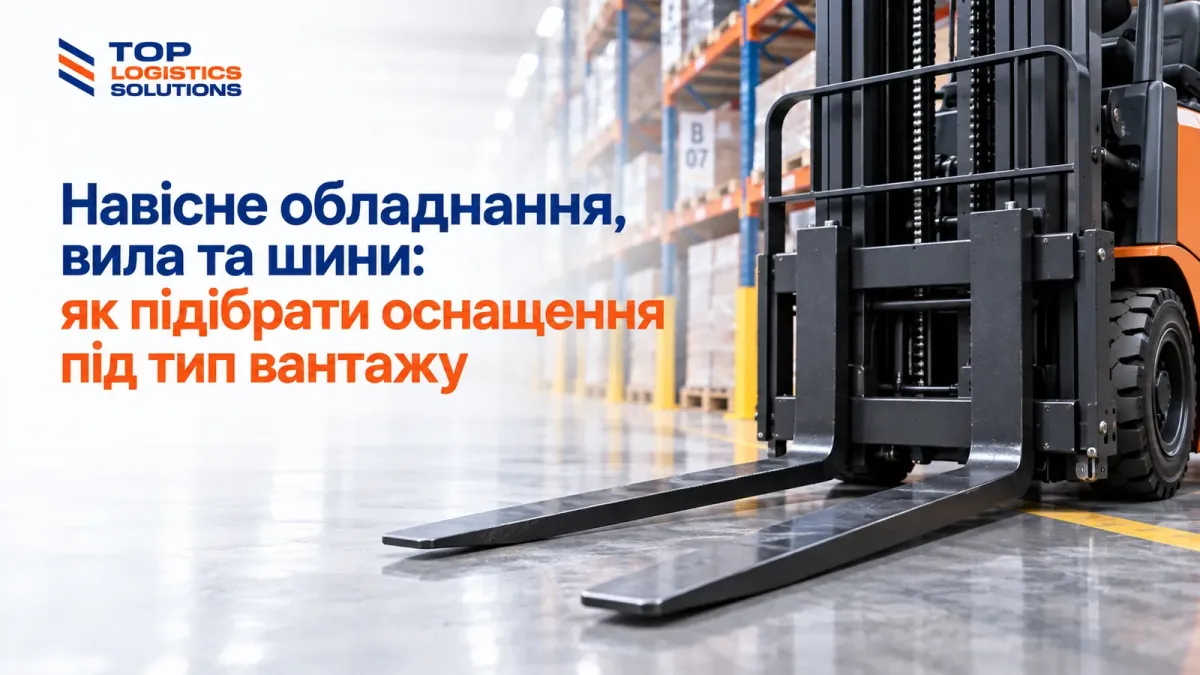
Equipment for warehouse machines is selected according to the weight, dimensions and gripping method of the load, and tyres according to the floor surface and the machine's route. Fork length and attachments affect the load centre and the residual load capacity. A correctly chosen specification shortens operation times and lets you use the machine's capabilities in line with the warehouse's actual tasks.
Start with the load characteristics
Before choosing equipment, record the maximum weight, the dimensions of the unit load, the position of its centre of gravity and the gripping method. These parameters will determine the fork length and the permitted load of the machine in its working configuration.
The position of the load centre has a direct effect on the load on the machine.
To illustrate: 2,000 kg at a load centre of 500 mm creates a nominal moment of 1,000,000 kg·mm. If the centre shifts to 700 mm, the value rises to 1,400,000 kg·mm, an increase of 40%. That is why the rated load capacity is checked for the specific geometry of the load.
When selecting forklift trucks, take the working height into account from the start.
The basic selection parameters are covered in more detail in the forklift selection guide.
 Equipment from this articleElectric ForkliftsView category
How forks and attachments change the machine's characteristics
Fork length is chosen to suit the load dimensions, and the attachment to suit the specific operation. A side shift makes precise positioning easier, a fork positioner changes the distance between the forks, and a rotator is used where the load has to be turned or emptied.
An attachment has its own weight and changes the position of the load relative to the machine. After fitting an attachment, check the residual load capacity at the required height. The same applies to a non-standard carriage, extended forks and other components that change the working geometry.
Which tyres to choose for the route
The tyre type is determined by the quality of the floor surface and the share of indoor and outdoor work:
- Solid tyres suit intensive routes and offer high puncture resistance.
- Pneumatic tyres absorb unevenness better on outdoor yards and rougher surfaces.
- Polyurethane wheels are used on compact electric equipment for level warehouse floors.
For a diesel forklift that regularly leaves the warehouse for asphalt, concrete slabs or an uneven yard, choose pneumatic or elastic tyres with a larger profile: they absorb shocks better and keep the machine stable on uneven surfaces.
For an electric pallet truck that works mainly on a level industrial floor inside the warehouse, polyurethane wheels are the sensible choice: they have low rolling resistance and compact dimensions, and they perform well on short routes between zones. If the route crosses slab joints, ramps or thresholds, check the wheel diameter and the permitted obstacle height separately when choosing wheels.
How to assess the economics of equipment options
Additional equipment is assessed through the time saved per operation and the annual utilisation of the machine.
If an attachment shortens the cycle by 20 seconds over 180 operations per shift, the saving is 3,600 seconds, or 1 hour per shift. Over 250 shifts, that is already 250 machine hours a year.
On this principle, warehouse equipment options can be compared with their operational benefit in money terms. Also include servicing and component wear in the calculation: the relevant indicators are analysed in the article on warehouse equipment maintenance.
Before purchasing, check the load weight and centre, fork length, attachment, residual load capacity and tyre type. This specification gives you a configuration matched to real operations and the expected utilisation of the machine.
CategoryElectric ForkliftsSelection of forklifts, forks and attachments for your loads.View category
 CategoryDiesel & LPG ForkliftsDiesel and LPG forklifts for heavy loads and outdoor work.View category
 CategoryElectric Pallet TrucksElectric pallet trucks for moving pallets around the warehouse.View category
 In stock
ProductCBH Electric Forklift 2.0 / 2.5 / 3.0 tLi-ion 80 V, load capacity 2.0 / 2.5 / 3.0 t.Learn more
 In stock
ProductToyota 40-8-FD-50-NDiesel forklifts for heavy loads and outdoor work.Learn more
Show us your warehouse.
We’ll take a look, then show you how to improve it
Leave your contact details and briefly describe the task. A TOP Logistics Solutions specialist will contact you, clarify the details and propose the next step.